Complete guide to the FIDE test

Everything you need to know about the FIDE test, with videos for each section.

Understand the test and what is really assessed.

Explore each section in detail, step by step.

Apply practical advice and concrete tips for exam day.

The FIDE test

What is the FIDE test?

The FIDE test assesses your French in real-life situations in Switzerland. It is notably required for the B permit, C permit or naturalization.

Two separate parts are assessed: Oral and Written. You receive a result between A1 and B1. Results are separate, so you only need to retake the part you did not pass.

  • Oral section (40 minutes) : speaking and listening.

  • Written section (1 hour) : reading and writing.

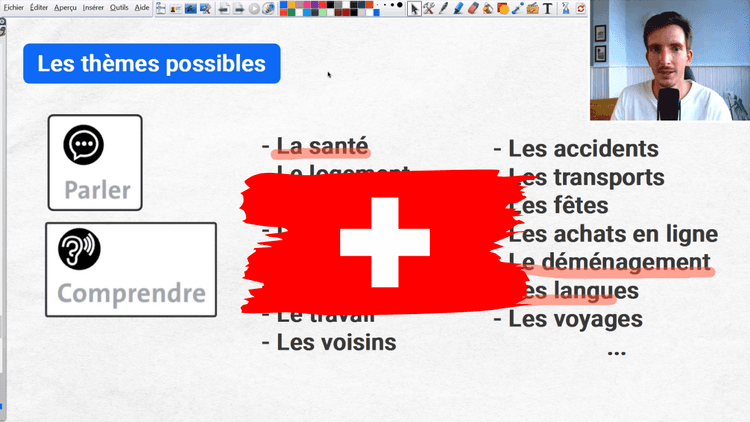
Common situations:

housingtransporthealthshoppingwork

Level A1

Very simple communication in immediate situations.

Level A2

Everyday exchanges with more autonomy.

Level B1

More developed responses in a range of situations.

The sections of the FIDE test

4 skills assessed: discover what to expect and how to prepare effectively.

Oral section: Speaking

The “Speaking” part is the most important and demanding oral section of the FIDE test. It lasts about 15 to 20 minutes with two examiners: one asks questions, the other observes and evaluates. The section always starts at A2 level, then you are directed to A1 or B1 depending on your performance.

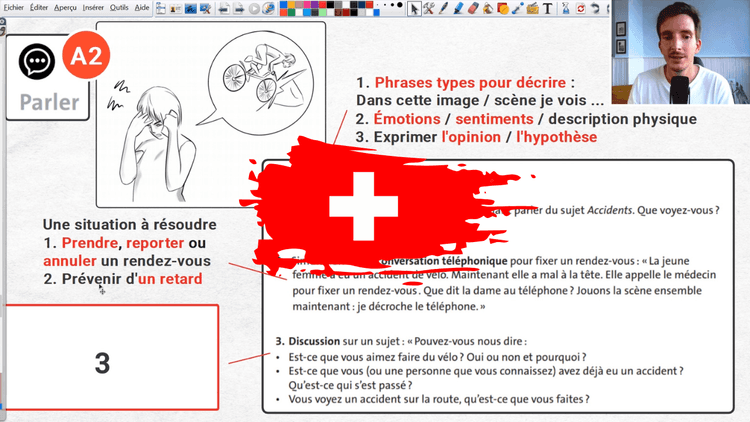
The 3 A2 tasks

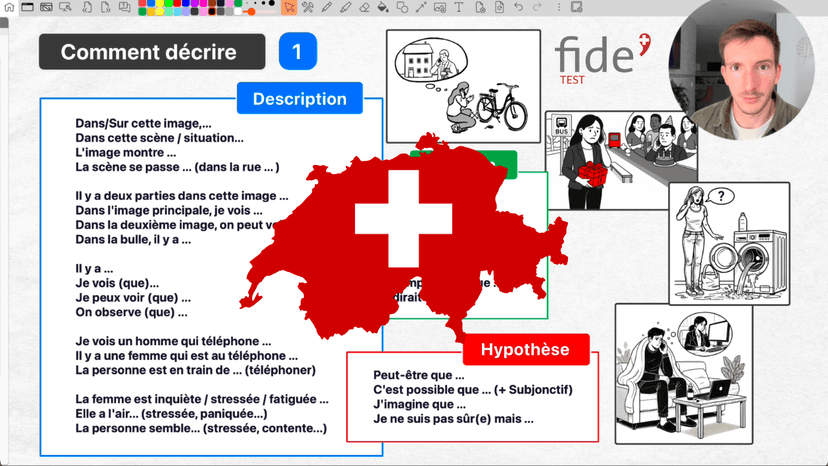
  • Image description: people, place, actions, and possible issue.
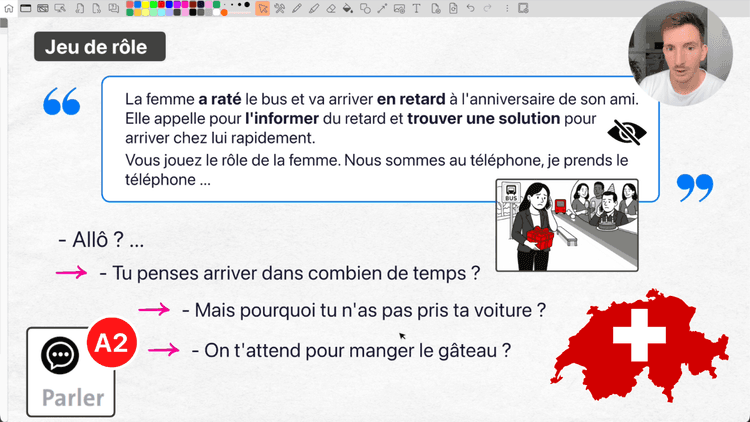
  • Role-play: often a phone conversation (canceling or rescheduling an appointment, etc.).
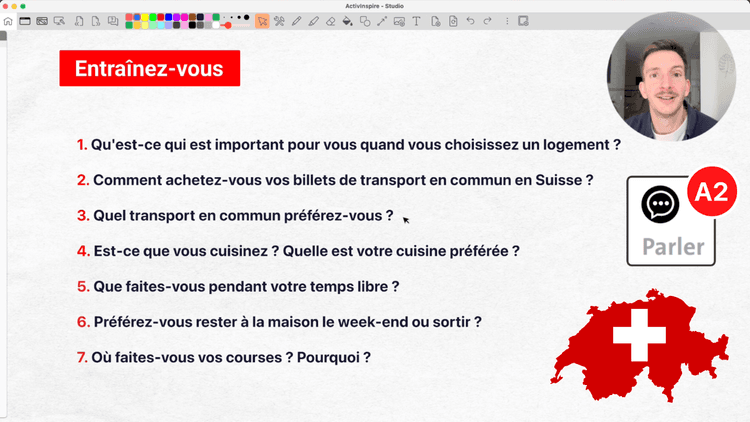
  • General questions on a theme to talk about habits, preferences, and experiences.

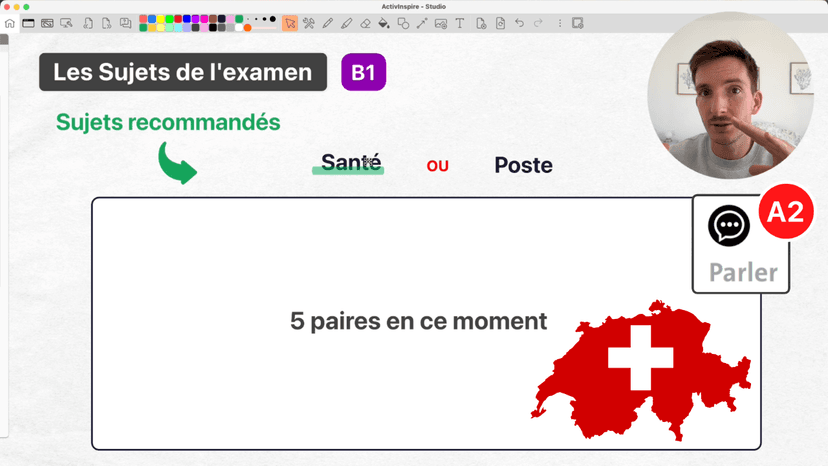
If A2 is successful, you access B1 level. At this stage, you choose between two topics and answer more developed questions: recount a past experience, present pros and cons, and answer hypothetical questions (often using the conditional).

Main advice: train with a teacher, especially to succeed in the A2 tasks and keep moving toward your B1 goal.

Oral section: Listening

The “Listening” part evaluates oral comprehension across three possible levels: A1, A2 and B1. The proposed level depends on your performance in the previous oral section. The goal is to verify your ability to understand concrete everyday situations.

Format by level

  • A1: short recordings linked to illustrated scenes, 3 questions per situation, answer by choosing the correct image. Audio can be played twice.
  • A2: similar to A1 but with more complex situations, longer recordings, and distractors.
  • B1: more natural and longer audios, oral response in full sentences based on what you heard.

Recommended strategies: ask for a second listen if needed, observe the illustrations carefully, trust your first impression, and review numbers, times and dates, which are very frequent in this section.

Listening comprehension represents one third of the oral score, while speaking counts for the other two thirds.

Train in the exact format? Mock examsRead the full guide

Reading and Writing

The “Reading and Writing” part is generally more accessible than the oral section because tasks are more structured and predictable. Since B1 is not required for naturalization or the C permit, the written part is usually not a major obstacle for candidates.

Structure of the written section

  • Duration: about 60 minutes.
  • Modules: depending on the target level, modules 1 to 3 or modules 4 to 6.
  • In each module: reading comprehension + written production.

Tasks are varied but clear: identify and copy information, fill out a form, answer an email or write a short letter, choose the right summary of a document.

The goal is to evaluate practical reading comprehension and the ability to produce simple messages that are still appropriate.

To improve, we recommend practicing with mock exams and their corrections.

Revise at your own pace? FIDE PackRead the full guide

Tips and strategies for exam day

Preparing for FIDE is mostly about practicing the right situations and adopting a stable method.
Goal: arrive calm, understand instructions quickly, and answer precisely in both oral and written parts.

Targeted preparation

Prioritize the everyday topics, with materials based on concrete scenarios.

Exact format

Train with FIDE mock exams, then complete with DELF A1/A2/B1 to strengthen comprehension and production.

Speaking work

Practice with a teacher: frequent scenarios, possible questions, useful phrasing, and introductory questions.

Key points to review

  • Image description and role-play: prepare simple, reusable structures.
  • Essential tenses: present, past, imperfect, future and conditional (B1).
  • Listening comprehension: use the second listen and focus on dates, times, numbers.

On exam day

  • Stay calm, articulate, and ask to repeat if needed.
  • For the written part, read instructions to the end and answer exactly what is asked.
  • Keep 2 minutes for a final review to correct avoidable mistakes.

Decide with confidence!

Let's build your FREE personalized study plan.

OR

Ask us your questions by email

Frequently Asked Questions about the FIDE

Find here the answers to the most common questions about the FIDE test.